|
Peeping into my youthful past, I recall three thick friends; Naren, Deepak and I walk our way to
college together every day.
I vividly remember the bright sunny morning, as we pass a large house with neatly manicured gardens, when a young girl rushes out into the greens, and abruptly pauses at the sight of three young men passing her gate. Wow! And isn't she a vision to behold! Fresh as the dew that basks in the early sun, and pretty as a rose bud. We freeze in our paths.
Congratulating ourselves on our discovery, we make it a point to pass Renu's house at that precise hour every day. Naren's fantastic information network has already discovered her name. And sure enough she is there, day after day. We float by in a trance, weak kneed, ogling at her, and excitedly discuss her later on the backbenches of our class.
And one day it finally happens. Renu gives us a dazzling smile and winks at us. The Romeos are floored and stupefied. This can't be true. Did we imagine it? It was too far fetched that all three of us to have imagined the same thing. Our hearts turn a somersault.
Eager for more, we pause expectantly by her house the next day, and lo, pat comes the smile and the wink. We are now positively starry eyed, and almost dance our way to college.
Strangely, Deepak looks rather thoughtful. "Come on man.. let's celebrate! She did it again." I try to cheer him into the general loony mood. "Really?" he retorts, "But there is a little catch. Who did she wink at? You, me or Naren?" I wake up with a start. Now, this is serious. I too wear his brooding cap. Naren looks up and joins the gloom." Certainly, she couldn't be winking at all three of us?". We don't bother to reply.
The smile and the wink fail to cheer us the next day. "Let's ask her upfront" I put in my two cents. They seem to agree, but the question of who will bell the cat still remains. We MUST find out which one of us Renu fancies.
Thinking hard, slowly but surely a game plan evolves. We decide to find out through planned experimentation. Instead of all three walking together, we decide to go past her house in a well-planned pattern of twos and singles.
Quickly, we put our plan into action. We already know Renu's response to all three of us walking together. We tabulate it as below:
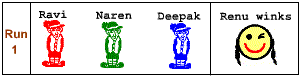
The next day, I stay back. Deepak and Naren walk together past her house. Much to my dismay, the smile and the wink greet them enthusiastically. We tabulate this result as:
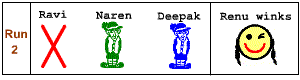
It's now Naren's turn to stay back. Deepak and I dutifully get the smile and the wink. Prompt in paperwork, we put down these results too.
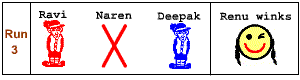
The data is building up, and we are all set to jump to wishful conclusions. We tell Deepak that she's just playing games, and keep him back at home. Naren and I take a confident walk, eager to prove our theory of Renu playing games, but are in for a shock. Renu simply does not make an appearance. Less sure about ourselves, we tabulate this result too.
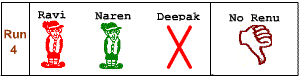
Deepak gives a laugh that love struck morons usually give, and suggests that we now walk one person at a time.
Naren and I dutifully do our role and encounter Renu's vanishing trick. Results are dutifully tabulated.
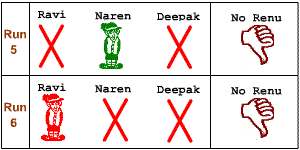
Deepak is on cloud nine by now. He puts on his best shirt, shines his shoes, and walks past Renu's house, chin up. He actually does walk up and down a couple of times, but Renu still fails to appear. Naren and I take sadistic pleasure in tabulating this result.
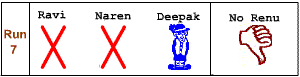
Deepak by now looks like a deflated balloon, and Naren and I are frankly perplexed.
"What's the meaning of this? Is she trying to twist us around her little finger?" Deepak is rightly antagonized. "Look, rather than jumping to conclusions, lets run this combination of experiments again. At the end of all the runs, we can analyze the data and form some hypothesis.", my statistics classes have started showing effects. They both agree to the suggestion.
"I am not going on a Friday." Naren gets a sudden urge to cling to superstitions. The order in which the runs would be carried out is decided by rolling a pair of dice, and the matter is settled. Over the next one week, we carry out the experiments again and the results are put together.
We are now ready for the judgement. We consolidate the results from both the sets of runs as follows:
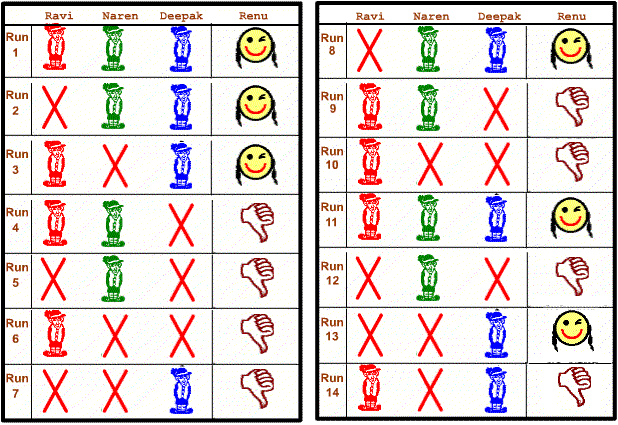
We decide to analyze the results by the change in Renu's response to the presence or absence of each of the Casanovas. Results (I discovered later that they were called effect plots in the DOE parlance) showed as follows.
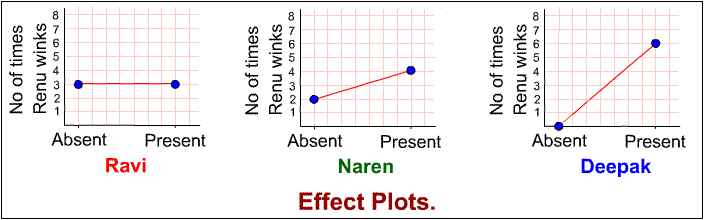
Obviously, Deepak is the clear winner. Naren and I shake Deepak's hand, wish him good luck and go on to chase the other damsels in the neighborhood.
Much later, when I studied statistics, and Design of Experiments, did I realize that we had performed a Factorial Experiment as we pursued Renu.
There were three Factors in this experiment. Naren, Ravi and Deepak. A factor is an independent variable in an experiment whose state can be varied. In a planned experiment, the factors are deliberately varied, all at a time, in a planned manner. The response is measured at every run of such combinations. In a scientific experiment, pressure and temperature of reaction could be two of the factors. These are varied across the experimental pattern, and the response characteristic (such as yield of the reaction) is measured.
Each factor was evaluated at two Levels. In this case, the person being Present or Absent. A level is a state of the factor that is deliberately varied. Experimentation is typically done at two, or occasionally three levels for every factor. The total combination of all factors and their levels can become too large and daunting a task if every factor is changed one at a time. An efficient experimental design that varies multiple factors at a time can reduce the number of runs to a great extent, still giving you enough information to be confident of the results. Levels can be discrete like the Present/ Absent levels that our experiment had, or can be numeric, like 80 degrees/ 100 degrees centigrade for the temperature factor in a chemical reaction.
The objective variable that you measure is the Response. You try and establish two facts by measuring the response.
- whether there is any relationship between the change in level of each of the factors and the change in response.
- what is the size of the change in response for a change in level for each factor (sensitivity).
In our experiment, the Response was attribute type. It was expressed as whether Renu winked or not. We could gage the size of the response by counting a favorable response to each factor at each level. Response can be variable type, like the change in purity from 90% to 95%. In such cases the numerical value of the response is and averaged for each level. The difference in response is called the effect, and is expressed using an effect plot shown above.
The experiment we conducted was Balanced, since each factor at each level was evaluated at an equal number of other factor- level combinations. A balanced experiment gives the same evaluation advantage to each factor, and helps in removal of bias that may creep in due to unequal amount of data for each factor-level combination.
What we achieved by rolling dice to determine the sequence of runs was Randomization. Randomization is very important, since it gives an equal chance to all external factors to affect every run of the experiment. A non-randomized experiment stands a great risk of external factors acting in a systematic manner and adding 'noise' to the response.
Running two sets of the experimental runs led to Replication. Two replications gave more data, and helped in evaluating the results with a greater confidence. More replications can make you surer about the effects, but also add cost to the experimentation process.
What then went wrong in run no 7 and run no 14? Why didn't Renu respond to Deepak's presence?
In the first case (run 7), it was a Lurking Variable that played a role. Renu happened to have a father who was built like a Gorilla and had a very foul temper. On the day Deepak went alone in the first Replication, the father had confined Renu to her room for some trivial reason. A lurking variable like Renu's father is external to the experiment, but strikes suddenly and randomly to affect the response, and confuse the results. Anyway, what could have been a more appropriate description of Renu's father than a 'Lurking Variable'?
In the second case (run 14) it was Renu herself who was in a foul mood, and refused to perform as expected. After all she was human, and couldn't be expected to fall in line with statistics all the time. This is the Experimental Error that is so often encountered in experimentation.
DOE can get more detailed when you perform ANOVA for comparing within-treatment variation with across treatment variation, but let's save that for another day.
I was lucky to learn structured Design of Experiments early in life!
Deepak married Renu, and went ahead to become a software professional. Deepak and Renu live in Boston.
Naren is a research scientist with a world-class pharmaceutical company in Philadelphia. Early training in Experimental Design undoubtedly prepared him for a great scientific career.
Ravi is the Managing Director of Symphony Technologies Pvt. Ltd. Do give him your feedback on this narration at ravi@symphonytech.com .
Author:
Ravindra Khare
Symphony Technologies Pvt. Ltd.,
B-4, Saket, Vidnyan Nagar, Bawdhan,
Pune 411 021, INDIA
Published: July 2002
|
Ravindra Khare is a Founder and Director of Symphony Technologies.
He is a qualified Mechanical and Industrial Engineer and a keen student of
Quality & Productivity Technology for the past 18 years.
He can be contacted at e-mail address: ravi@symphonytech.com
or through us at info@symphonytech.com
|
|



 Top
Top


